A Midsummer Night's Dream
Shakespeare wrote a Midsummer Night's Dream between 1590 and 1596, and it soon grew to be one of his most highly acclaimed comedies. It takes place in ancient Athens, and many references in its story has to do with Greek myths.
What Happened?
Here's the storyline, simplified: It's set in Athens. Duke Theseus (he's the guy who slayed the Minotaur) has just arrived from the Amazon, along with Hippolyta, a warrior-princess, to whom he is to be married. But as soon as they come into Athens, they are confronted by Egeus, the father of a fair maiden named Hermia. Hermia is to wed a man named Demetrius, but she rejects him, and instead wants Lysander. Meanwhile, a woman named Helena dotes on Demetrius, although he thinks she is... well, disgusting, I suppose.
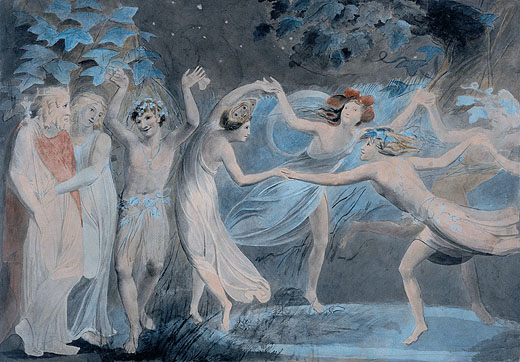
Later that night, Hermia and Lysander decide to elope, and they run away through the forest. Demetrius follows them not too far behind, and poor Helena is left to follow Demetrius. Eventually, Lysander and Hermia fall asleep deep in the forest, where the fairies live. Oberron and Titania, the faerie king and queen, have been fighting over Titania's godson. Their fights have brought storms over Athens.
A faerie named, Puck, quite the trickster, was ordered to put a love juice in Demetrius' eyes. He was ordered to do this because Oberron saw Demetrius and Helena arguing, and wanted to make them fall in love. Unfortunately, he puts it in Lysander's eyes instead, and Lysander falls in love with Helena! After another mistake by Puck, Demetrius has also fallen in love with Helena! In one night, the love circle has completely changed directions.
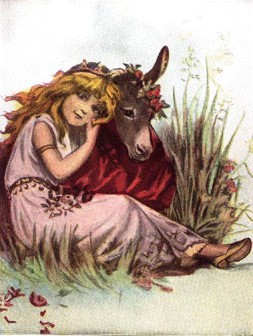
Meanwhile, a group of rude mechanicals, hard-working men of Athens, are working on a play to put before the Duke of Athens and his new bride. While practicing, the main character, Bottom, is turned into a donkey by Puck. Titania, with love juice put into her eyes by Oberron as a trick, falls in love with Bottom.
Eventually, Puck reverses the love potion and turns Bottom back into a human. Lysander and Hermia are back in love, Oberron and Titania are back in love, and Demetrius has finally fallen in love with Helena. The final act in the play is where Bottom runs back to the rest of the Rude Mechanicals and tells them that they must perform their play. The Rude Mechanicals perform (badly) for the Duke of Athens and his company in one of the most hilarious scenes in Shakespearian writing.
The play ends with a epilogue from Puck announcing that the play was just a dream, and that if it was not enjoyed, then all is forgiven.
Brief Analysis of the Play
Unlike many of Shakespeare's plays, which have to do with moral choices, greed, and regret, A Midsummer Night's Dream lightly touches upon the theme of love and the power of love. Puck is a scallywag version of Cupid, making people fall in love and watching the outcome. Lysander, Hermia, Demetrius, Helena, and Titania are all victims of love, but eventually, it all comes out well in the end. Titania's love for Bottom the donkey (see the picture above) upon receiving the love potion seems to show that love is blind, and we are all casualties to its will. She didn't care what he looked like. Love made her love him all the same.
It's also worth noting that while the lovers laugh at "Pyramus and Thisbe," the play within the play acted out by the Rude Mechanicals, they don't seem to understand that it represents themselves: the characters in the play are also star-crossed lovers, running away so that their love can be free. Lysander and Hermia are apparently oblivious to this obvious reference.
Still Popular Today
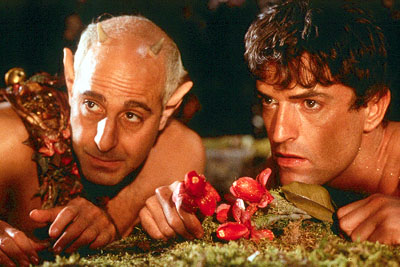
Like most of Shakespeare's plays, A Midsummer Night's Dream remains one of the most popular Shakespeare plays of all time, due to its themes of love and its outrageous comedy. It's been made into a movie about 4 different times, and has had uncountable amounts of movies and TV show episodes based on the story. One of the most popular adaptions is from 1997 (see the picture at right). Of course, it has had several stage adaptions as well, with another major adaptation appearing somewhere in the world every five or ten years.
The script of A Midsummer Night's Dream was first printed in 1600, about 5 years after it first appeared on stage at the Globe Theater. Nowadays, you can download the pdf script online for free! Just look below!

|
midsum.pdf Size : 360.488 Kb Type : pdf |