The Many Plays of William Shakespeare
In his career, Shakespeare wrote a total of 37 plays, about half of which weren't even published until after his death. There were comedies, tragedies, and histories, and had universal themes that are so common that the characters in the play still seem new and relateable today.
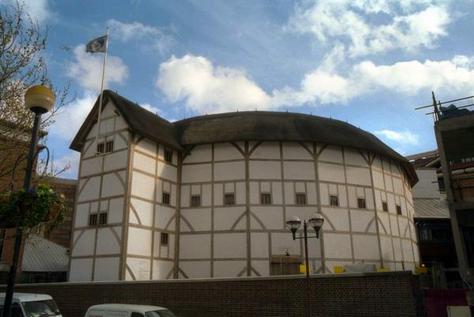
All of Shakespeare's plays were performed in the original Globe Theater in London. Only Shakespeare's acting troupe were allowed to act out Shakespeare's plays. In fact, that was the law! When Shakespeare died and his plays reached worldwide renown, pretty much anyone could recreate Shakespeare's legendary plays, from elementary school kids to veteran actors on the big screen!
Also, it must be pointed out that ALL of Shakespeare's plays have five acts, no exceptions. The third act is usually the climax of the story.
Left: The Globe Theaer, where all the acting took place!
List of Shakespeare Plays
Okay, I'll admit it, I'm not going to put in 37 plays. Instead, this list is divided into the three categories of Shakespeare's plays, along with the best known 3 or 4 of them. Many of the plays, much like with the "People of the Renaissance" page, will have links to a separate page all about that one play. After all, there's a lot to say!
Histories
Earlier in his career, Shakespeare mainly wrote about histories. Histories were always written about the lives or a portion of the lives of Kings of England. Here are his best known histories:
King John
King John was the King of England from 1199 to 1216, and the play romanticizes the trouble in his life. His country is going into turmoil, and eventually he makes some bad decisions that the church decides that he has gone directly against the ambitions of the Pope, and poor John is excommunicated. More war happens, conditions gets worse, and in the end, King John is poisoned by an angry monk. Those still loyal to him gather around as he takes his dying breaths, and the play ends.
King John used to be an extremely popular play, but since then its popularity has dropped. Nowadays it's one of the least-known of Shakespeare's plays, and we can only wonder if it will ever be brought back.
Henry IV, Part One and Part Two
This was one of Shakespeare's first plays that he had ever written, and the first that was performed at the Globe Theater. In Part One, Henry is shown to be King, right after King John. He is at war with the Welsh, and his son is a low-down, rowdy thief. Hastily, he tries to fix both problems, but to no avail. It ends with a battle, where the outcome is left unknown.
Part Two, then picks up three whole years after Part One. Henry has gotten an illness, and is sure to die. There are many fights and executions, and in the end, Henry IV passes away. Horrified by his father's death, his son, Hal, vows to leave his wasted life and become heir to the throne.
Richard III
The War of the Roses is in full bloom (Get it? The roses bloom!). This war was two warring families in France against Richard and his kin in England. Richard plots to kill off his two brothers so he can get the crown. One of his brothers, Edward, was very ill at the beginning of the play and soon dies. As for the second brother, Richard throws him into prison on charges of treason and plans to have him murdered in there. Richard becomes mad with power and greed, not letting Edward's children rise to the throne on the basis that they are "illegitimate." He even alienates his own mother!
Later, the French are planning to attack the English in the final battle. The night before the fight, Richard is visited by the ghosts of all the people who he has murdered, and they all spell out his doom. Richard ignores them and the next day he and his troops march into battle. But Richard is knocked off of his horse and killed. Without its ruler, England must surrender, and the French win. So ends the War of the Roses, Richard the Third, and the play.
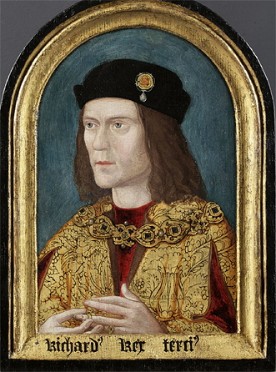
Right: An early portrait of King Richard III, who ruled from 1452 to 1485. IF you look closely at the cryptic writing under his portrait, it actually does read Richard the Third, but in very early English.
Comedies
Ha ha ha! More than any other type, Shakespeare wrote comedy plays. These were usually the shortest plays, but were bursting at the seams with funny jokes, satire, and characters. Check them out below:
The Tempest
The Tempest is actually probably the last play that Shakespeare ever wrote, as well as the most complex one. It should also be noted that while it was originally classified as a Comedy, it had so much dark themes in it, that it is relatable to a tragedy as well. Nowadys, people like to call it a romance, because romances are a clean mixture of the two genres.
The play starts with Prospero, a sorcerer and the rightful Duke of Milan, who lives on an isle far away with his daughter, Miranda. Twelve years earlier, Prospero's brother had stolen his throne and banished him. Suddenly, a ship starts sailing nearby the Prospero's Isle, and Prospero summons a typhoon to destroy it. Among the shipwreckd is the son of a man who had conspired with Prospero's evil brother, and Miranda soon falls in love with him.
Although Prospero initially distrusts the new man, he soon grows to accept him. As for his brother Prospero travels to Milan and pulls numerous pranks on him, such as making food for him that disappears when the brother tries to eat it. Then Prospero reveals himself. Luckily, the play ends happily, with Miranda in love and with his brother begging for forgiveness. Prospero decides he doesn't want to be the king anyway and sails back to his island.
Much Ado About Nothing
Besides "A Midsummer Night's Dream" (see below), Much Ado About Nothing is Shakespeare's most famous comedy. It tells the story of four travelers who come to Leonata, governor of Messina. Their names are Don Pedro, Don John, who is Pedro's mean brother, and two officers named Benedict and Claudio. Claudio and Leonata's daughter fall in love, and Don Pedro tries to arrange a marraige.
But that tricky Don John is plotting against his brother, and puts together a bunch of schemes to ruin everyone's day. For example, he tells Claudio that Don Pedro wants Leonata's daughter to himself, which sparks Claudio to fight with Don Pedro.
Don John escapes among the madness, and Leonata breaks up the fight by declaring that his daughter had died of grief. Luckily, he was only lying to cover himself up, and Claudio and Leonata's daughter are finally reunited. Additionally, Benedict falls in love as well.
And what about the conniving little Don John? Well, when trying to escape, he is apprehended, and the play ends with him being taken away while the other characters are enjoying each other's company.
A Midsummer Night's Dream is one of the most highly acclaimed, commonly reproduced Shakespeare plays of all time. In fact, we have an entire page just on the one play! (Click on the title to bring yourself there.)
A Midsummer Night's Dream is about romance, confusion and fantasy. In Athens, Hermia is to be wed to Demetrius, a man who she simply doesn't love. She loves Lysander, but they are forbidden from marrying each other. Meanwhile, Demtrius used to love a girl named Helena, but now doesn't, even though she still dotes on him. This creates a confusing love circle.
To make matters worse, the fairies are out and about in the modern world, and a trickster named Puck is bent on making everyone fall in love with the wrong person. To make matters even worse, there's a group of hard-working individuals who are trying to create a play for the duke of Athens, but everything goes downhill from there when their main character is turned into a donkey!
You can see why I needed a seperate page for this!
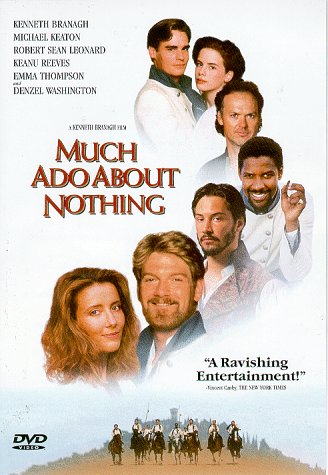
Left: The box art for Much Ado About Nothing, which was made in 1993. It was a moderate success. In fact, virtually all of Shakespeare's plays have been reproduced at least once, from silent black-and-whites of the early 1900s to huge blockbusters that we have today!
Tragedies
What is a tragedy? I'll give you a hint: everyone dies in the end. Okay, while this doesn't pertain to all of Shakespeare's tragedies, it certainly is a recuring theme! Tragedies remind of us of our faults, our emotions, and of our morality. I've got four of the most popular below:
"Double, double, toil and trouble..." Hopefully you know that these words were originally spoken by the witches in Macbeth!
Macbeth is actually Shakespeare's shortest tragedy, but still has a lot of important morals to it. And states what happens when you get too greedy, and lie or kill to get what you want. Macbeth (and his wife) learned this the hard way, and one by one people die or go insane inside the castle in one of Shakespeare's most interesting plays. There's suspense, magic, and fantasy, and much more. There have been tons of novel, stage, and movie adaptations of it.
In fact, we have a whole page on the play, in which the full name is The Tragedy of Macbeth! Just click the name to see it.
King Lear
Though King Lear is a tragedy, not a history, it's actually based on a real King that lived in in the same area, who was Celtic. The King Lear from the play is an aging King of Britain, who needs to give his throne to one of his three daughters. His eldest two are actually evil and seek his throne and lie about their unending love for him. His third daughter, Cordelia, who really does love him, simply states that she does. But Lear is outraged that Cordelia isn't nearly as loving to him as his other two daughters, and she is kicked out.
In the meantime, the eldest two daughters have taken over and King Lear discovers that they never really loved him, but only sought his power. He is treated like an old beggar man, and greatly regrets his decisions. The evil daughters send Lear and Cordelia to be hanged. But the two are saved when they find out that one of the elder daughters killed the other, then poisoned herself out of grief.
Left with nobody but his only loving daughter, King Lear dies, greatly ruing the choices he made.
Raise your hand if you know the story of Romeo and Juliet. You better have your hand raised, because it's one of the most universal love stories of all time. "Two houses, both alike in dignity," are at a Cold War with each other: fighting in the streets, you know the deal. But what happens when Juliet, a Capulet, falls for Romeo, a Montague?
Unfortunately, tragedy happens. Many people lose their lives, including the star-crossed lovers themselves.
For more info on this ridiculously famous play, click the (you guessed it) title, and you will be teleported to the Romeo and Juliet page!
Prince Hamlet of Denmark is grieving his father's death, and is angry that his evil uncle now gets the throne, along with Hamlet's mother as his wife. He believes that the uncle murdered his father, and he is proven right when one fateful night, the ghost of Hamlet's father greets Hamlet, and tells of the uncle murdering him.
But how do you take countermeasures against murder? With more murder! Hamlet goes mad with trying to prove that his uncle is a killer, and eventually kills the father of his love, Ophelia. Then Ophelia goes crazy and kills herself. Shortly after there is a play within the play, and a final fighting scene with poisoned swords!
Yep, that's right, we have a page on Hamlet too! Just click on the title.
Too Many Plays
Of course, I didn't list all of the 37 plays. I only listed ten! But for the four in which I have links to the actual page, you should look at them. The individual pages have way more info on the plays then I could ever fit into this puny little page.
The point is that in his relatively short lifetime (52 years), Shakespeare wrote a huge amount of plays, and so many of them have slipped into our common living and media that we hardly even notice them. But look around; there's a lot of stuff that takes stuff from Shakespeare's plays.
And what about you? What's YOUR favorite Shakespeare play?
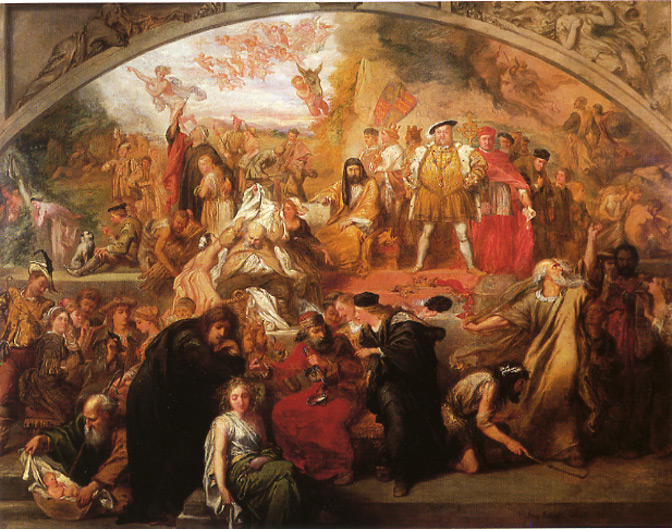
If you look on the right, you'll see a painting by Sir John Gilbert. This 1849 painting, aptly named "The Plays of Shakespeare," includes characters and scenes from several of Shakespeare's works, such as Henry VIII and A Midsummer Night's Dream.