What was the Renaissance?
The Renaissance, basically described, was a massive cultural European movement that started in the 1400s and continued for another 200 years (However, true dates vary, see the Timeline of the Renaissance page). It sparked the flames for an undaunted amount of intuition and creativity, and produced some of the most famous and imaginative people of all time. Most scholars agree that it started in Italy, but soon grew over time to Spain and England. The volcanic burst of intelligence was almost like a disease, spreading to every corner of Europe.
The Renaissance defined moving forward. In essence, it defined the creativity and inventiveness of the human race.Why do we Care?
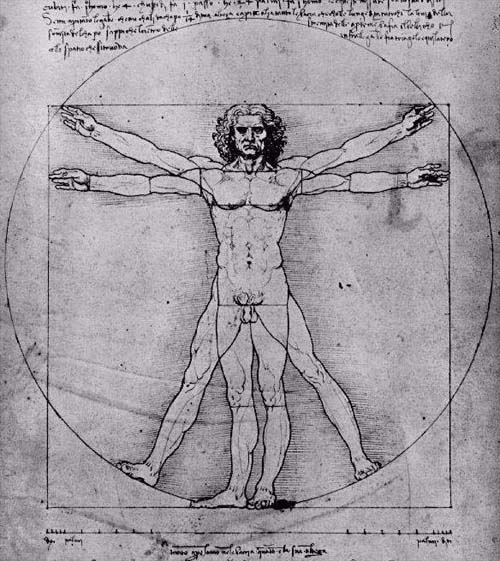
There's a lot we can learn about the Renaissance. It was the pinnacle of existence, equal in its might to the high-end, technology-savvy world we live in today. Many forms of art, poetry, and theater are still used today, as well as greatly respected. The inventions that great minds such as Leonardo da Vinci created as well as their concepts were taken by more modern inventors and changed into things we have today, such as the hot air balloon and the helicopter. Designs from back then are still used today. Other magnificent accomplishments include the Vitruvian man, pictured at left. This sketch, by Leonardo Da Vinci, was one of the first ever accurate depictions of the normal human body.
How did it start?
This is a difficult question. Firstly, the Renaissance's word roots literally mean "born again", with "re-" meaning again and "-nesance" meaning to be born. This was because after the "Dark Ages", the medieval time span that lasted from the fifth to fifteenth centuries, creativity was finally reborn! The Renaissance just seemed to have sprung up after the fall of the Dark Ages, during the 1500s. Knights, castles, and the plague were replaced by poets, sculptures, and plays. There were many social and political developments going on, and there finally were no more Crusades or any other major wars. This gave mankind the opportunity to focus more on the arts, and before you could say "To be or not to be," the Renaissance was officially born, and boy, was it blooming!
Will it happen again?
Interestingly,the answer is almost certainly no. The Renaissance was the rebirth of imagination, creativity, and the arts, stemming from a long age of lack of intellectuality. Without the Dark Ages, the Renaissance would have never happened in the first place. The truth is that we still are living in the Renaissance, at least in certain ways. We keep on creating, inventing, and discovering. Since so much of what we see and do today was affected by the Renaissance, we in turn are still living our artistic lives the same way people did centuries ago. Europe, or the entire planet, for that matter, will never again get such an uprising of creative intelligence as was witnessed during the Renaissance.
A New Age for Art
Before the Renaissance, there were no plays, and poetry such as sonnets didn't even exist. There was always art, but there are several obvious changes between Renaissance and the earlier medieval art:
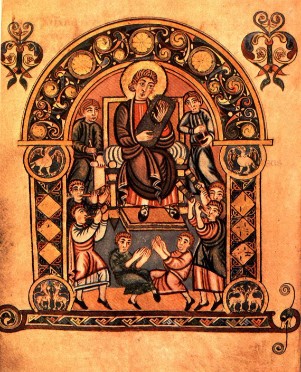
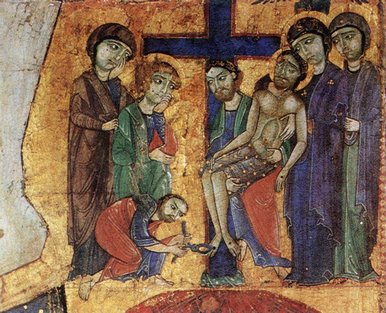
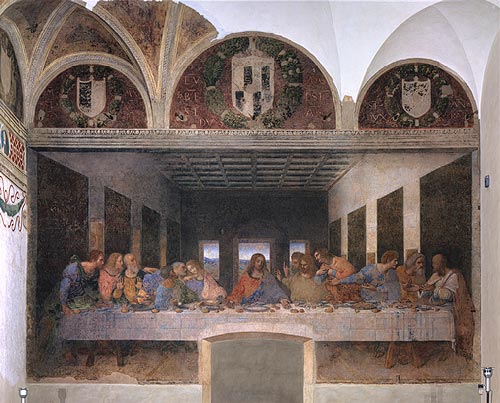
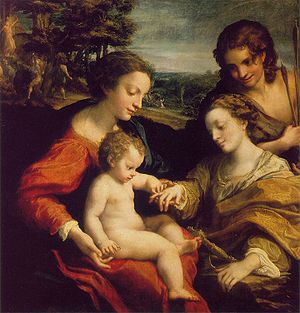
Observe the four paintings below this section and the "How did it start?" section. Two are from the Renaissance, and two are from medieval times. Now, it's easy to differentiate the two. The two on the top are medieval, and the two on the bottom are Renaissance. The differences between the two art forms aren't very subtle.
Medieval:
Medieval paintings were completely two-dimensional, with no visual depth to the picture. Look at the two medieval paintings at the top. The people all look like they're standing next to each other, when they could be any distance behind or in front of the other. All people and items in the paintings are featured in simple overlapping layers, with no comparison to how far away they are or any kind of shadows.
Also notice the faces on the characters of the medieval paintings. Their faces all look the same, and have little or no facial expressions. They look more dull and less lively then a person would look in real life.
Renaissance:
Renaissance painters experimented more with light and shadows, as you can see in the bottom two paintings, one of which is "The Last Supper" (For more on The Last Supper, check Leonardo Da Vinci's page). There is more depth to the paintings as well; in The Last Supper, you can see the columns behind the table heading towards the horizon and getting smaller and darker, showing that they are in the background.
As for facial expressions and the realism of the characters, the people in the Renaissance painting look much more lively. They look as if they are in mid-sentence, and are smiling or frowning or making hand gestures, making them look more realisticically human.
Awesome Inventions
There were also many things made in the Renaissance that just plain improved daily life. For example, the first mechanical clock was made in the 1300s, at the very beginnings of the Italian Renaissance. Shortly after came eyeglasses, and of course we must keep in mind that Galileo (see him here) greatly popularized the microscope and telescope in his time! Of course, Leonardo da Vinci also created or improved upon a huge amount of inventions and concepts, ranging from war to flight.
One of the Weirdest Inventions Ever
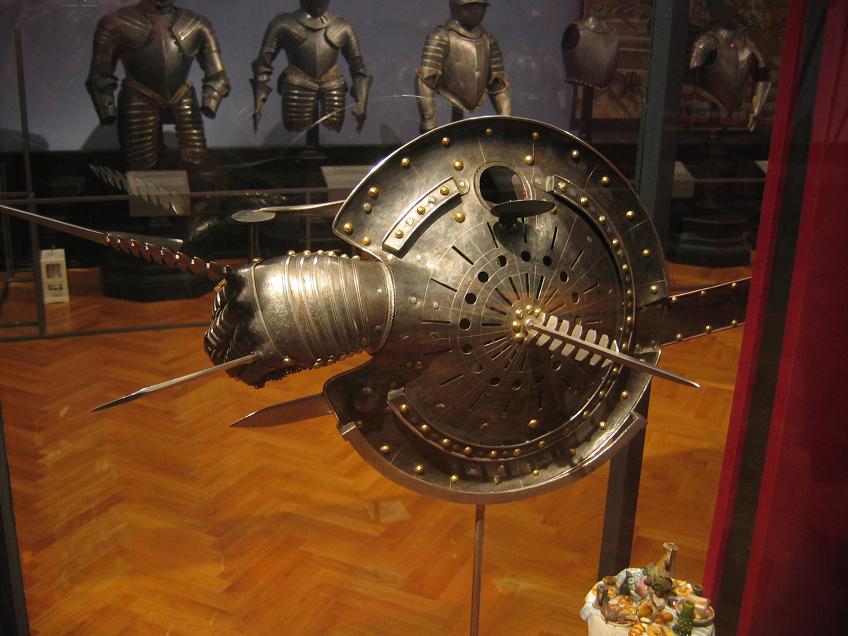
However, amidst all of the great inventions of the Renaissance, I believe one proud creation may stand above all as one of the strangest inventions of the Renaissance. Ladies and gentlemen, I give you... The lantern shield.
If you're looking at its picture to the right, then you probably have an idea of how weird it was. Developed in Italy, in the 16th century, the lantern shield was a war device intended to serve both as a weapon and a shield. The gauntlet part would cover your hand like a glove, and then you would be ready for action! The shield part would protect from enemy fire, and the spike on the ends would be used for stabbing people.
True to its name, the lantern shield even had a small lanten hidden inside the shield. It could be taken out to lead the way through the dark, or quickly flipped open to blind the enemy with sudden light. No wonder it was called the "swiss-army shield"! Still, it was never used in any wars, and there are only a few intact ones in existance.
So Much To See
But art was not the only thing that advanced during the Renaissance! In the next page (if you're like me, and you always read the pages in order), we'll take a look at famous people of the Renaissance, those bold and intelligent guys and gals that made Europe the greatest and most creative place on Earth in that era!

