Lots and Lots of Sonnets
When William Shakespeare wasn't writing plays, he was writing poetry. In fact, over the course of his lifetime, Shakespeare wrote 154 of them! Their subjects ranged from getting old to falling in love to never being with a loved one and more. The first book with all of Shakespeare's sonnets was published in 1609, seven years before his death.
Origin of the Sonnet
The origin of the sonnet can be traced to a man living in Italy in the 1200s named Francesco Petrarca. It was said that one day Petrarca was walking along the street when he saw a stunningly beautiful woman named Laura. As the tale goes, he immediately went home and dedicated a poem to her. Petrarca wrote even more sonnets than Shakespeare (about 250), and nearly all of them were about unobtainable love.
The Petrarchian sonnets, however, were different than the Shakespearian sonnets, also known as the English or Elizabethan sonnets. While both sonnet types had fourteen lines, Petrarchian sonnets had a greatly different rhyme scheme, and were ultimately quite different forms of poetry. It wasn't until the late 1400s that Shakespeare borrowed Petrarca's sonnet, twisted it around a little, and made it into his own.
What makes a Sonnet?
Shakespearian sonnets were different than Petrarchian ones; every type of sonnet had different guidelines. Here are some rules that must be applied if you're writing a Shakespearian sonnet.
-Each sonnet must have 14 lines, no exceptions
-There must be three 4-line stanzas, with two individual lines at the end
-Each line must have 10 syllables
-The syllables of each line must switch between stressed and unstressed
-The 14 lines must follow the iambic pentameter rhyme scheme. This means it must be: a,b,a,b,c,d,c,d,e,f,e,f, g,g
While sometimes Shakespeare's sonnets had some exceptions, usually he would goes as far as changing word spelling to make sure that all of his sonnets were legit.
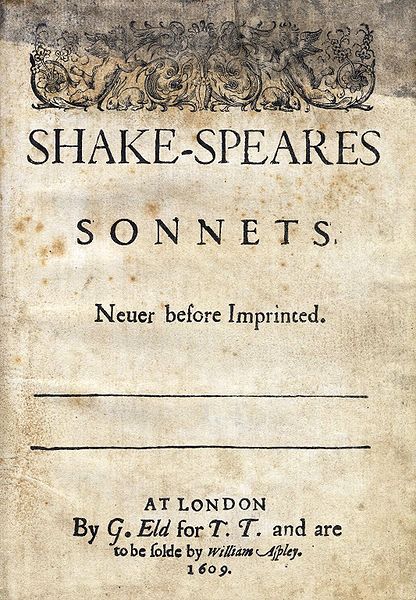
Left: The first published edition of "Shakespeare's Sonnets."
Shakespeare's Sonnets in His Plays
In Shakespeare's many plays, he would include sonnets. The most famous of these is "Romeo and Juliet," which included a legendary sonnet in its prologue:
"Two households, both alike in dignity,
In fair Verona, where we lay our scene,
From ancient grudge break to new mutiny,
Where civil blood makes civil hands unclean.
From forth the fatal loins of these two foes
A pair of star-cross'd lovers take their life;
Whole misadventured piteous overthrows
Do with their death bury their parents' strife.
The fearful passage of their death-mark'd love,
And the continuance of their parents' rage,
Which, but their children's end, nought could remove,
Is now the two hours' traffic of our stage;
The which if you with patient ears attend,
What here shall miss, our toil shall strive to mend."
This prologue, recited at the very beginning of the play, described - as all of Shakespeare's prologues did - what happens in the play. The only difference between Romeo and Juliet's prologue and other plays' prologues was that this one was a sonnet.
Also, when Romeo and Juliet first kiss ("If I profane with my unworthiest hand"), the speech that switches off between Romeo and Juliet is a cleverly devised sonnet as well.
Shakespeare's Most Famous Sonnet
"Shall I compare thee to a summer's day?
Thou art more lovely and more temperate:
Rough winds do shake the darling buds of May,
And summer's lease hath all too short a date:
Sometimes too hot the eye of heaven shines,
And often is his gold complexion dimmed;
And every fair from fair sometimes declines,
By chance or nature's changing course untrimmed;
But thy eternal summer shall not fade,
Nor lose possession of that fair thou ow'st;
Nor shall death brag thou wander'st in his shade,
When in eternal lines to time thou grow'st:
So long as men can breathe, or eyes can see,
So long lives this, and this gives life to thee."
The above sonnet, Sonnet 18, is without a doubt Shakespeare's most popular sonnet that he's ever wrote. In fact, many of us have probably heard it before without even knwoing that it was a sonnet.
Like many of Shakespeare's sonnets, Sonnet 18 is about love. Not about lost love, but affection of the highest degree. Shakespeare uses lots of imagery from nature that really brings his poems to life. He also takes advantage of figurative language whenever possible.
Also note that in the 10th line, Shakespeare shortened the word owest to ow'st in order to make it one syllable and fit the rhyme scheme.

Top: Perhaps the summer's day Shakespeare was comparing to resembled this one? Either way, Sonnet 18 is a pretty amazing piece of work.
Colorful Characters
Shakespeare's sonnets were usually dedicated to individual, made-up characters. Sometimes he dedicated dozens of sonnets on a story for one of his characters. There are two that sand out the most, the "Fair Youth," who Shakespeare shares a brotherly, possibly father-son relationship with, and the "Dark Lady," black-haired woman that Shakespeare appears to be bewitched by.
The Fair Youth is a young man that Shakespeare (usually seen as the narrator of the poem), shares a close, perhaps familial relationship. Although nobody is sure who Shakespeare modeled this character after, amny believed that he based his many poems on Henry Wriothesly, one of Shakespeare's many supportive patrons and friends. Shakespeare dedicated a huge amount of his sonnets to the Fair Youth, meaning the vast majority of his love poems were directed toward the Fair Youth. Love comes in many forms.
Another recurring character n Shakespeare's sonnets is the Dark Lady, who Shakespeare loves with a fiery, irrational passion. She had been identified as having beautiful dark hair and dark skin, and it is unknown who Shakespeare modeled the Dark Lady after. Sonnets 127 to 152 are all said to be directed toward the Dark Lady.
The Rest of Shakespeare's Sonnets
Shakespeare dedicated his 154 sonnets to love, to time, and to nature. He wrote with his pen and his heart in hand. In fact, his last two sonnets were talking about Greek myths, and the power of Cupid and the love that he controls.
Nowadays, people everywhere - children and adults alike - are studying Shakespeare's Sonnets. The amount of passion he put into his poems is breathtaking, and each sonnet has a universal feeling of love to it. William Shakespeare's sonnets marked the return of poetry, and were yet another amazing group of feats that pulled creativity into the Renaissance.

