Galileo (Also Known as the Father of Science)
See that title above? The "father of science." That's a pretty big deal. You had to have been an extremely amazing person to deserve that title. And Galileo was! Born in 1564 (which makes him the latest person on the list), Galileo was a stargazing genius. And it wasn't just astronomy, and astronomical inventions such as his invention of the first modern telescope. He was also a big physics-guy and overall an archetypal man of science.
Galileo's Beginnings
Galileo was born into a middle-class family living in the province of Pisa, which is in Florence.He was one of six children. Like most of our Renaissance geniuses, Galileo's teachers found him to be a bright and inquisitive young man, even though he at first didn't think of attending college. Instead, he was mainly educated at a Catholic monastery.
Later, Galileo could finally get into the University of Pisa, which was the best university in the area. There he studied mathematics, and then became extremely interested in physics. Later in his years at the university, he came to be head of the mathematics division. Later, he started to do his own individual work and theories.
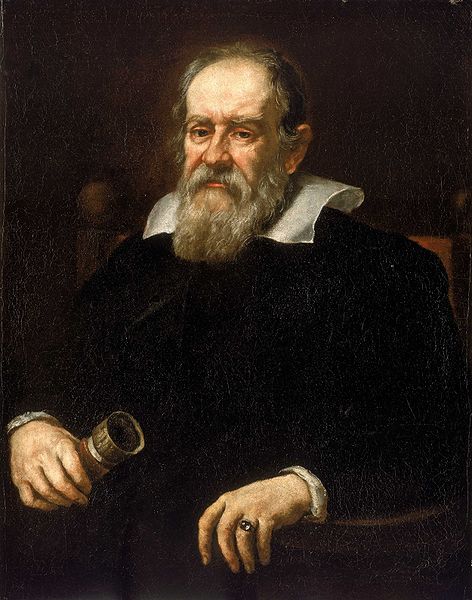
Left: This indeed is a portrait of Galileo, with his trusty miniature telescope right at hand.
Talking 'Bout the Tides
One of Galileo's primary interests when it came to physics and gravity was the tides. The tides were a major proof of Copernicus' Heliocentric theory because there would be no tides if the Earth stood still. In his theory, Galileo stated that the regualr motion fo the tides proved that the earth was constantly moving. The tides sloshing back and forth around the Earth is a result of the Earth rotating on its axis around the sun.
Galileo released his theory in 1616, to much praise but much more criticism. It's too bad that Galileo completely dismissed the thoeries of his friend Johannes Kepler that it was actually the moon that caused the tides. Also, Galileo didn't think that the planets followed an oval-like, elliptical axis, but went in a circle around the sun. But hey, everyone makes mistakes.
Major Steps in Astronomy
Galileo was quite the starry-eyed fellow - literally. Just like Nicolaus Copernicus, he was fascinated by space. Galileo made his first telescope, with a 3x magnification, in 1608, and from then on kept improving it until it he had 30x magnification, which was WAY advanced for his time! He published his first book about astronomy, "Starry Messenger," in 1610. These were some of the things he discovered:
- He was one of the first people ever to observe sun spots, those dark patches on the sun where it its cooler
- He also was the first to observe that Venus had phases, just like the moon. He used ths observation to back up the theory of Heliocentrism.
-He discovered the first four known moons of Jupiter: Callipso, Io, Europa, and Ganmeyde
- He was the first to identify that the moon indeed had craters, mountains, and valleys, rather than being smooth
- He may have been the first astronomer to discover Neptune, as seen in his notes in 1612, though he figured it was just a faraway star
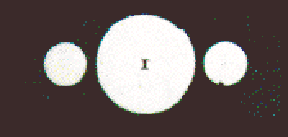
Also, when Galileo was looking at Saturn, he could not closely identify its rings, and saw them as just circles flanking Saturn. This led him to believethat Saturn was actually three planets: the middle, larger one, and two smaller ones at its sides. People didn't know they were rings until decades later.
Either way, Galielo saw a lot of things through his telescope that weren't even dreamed of before. When people found out about Galileo's crazy discoveries about the moon's surface and Jupiter's moons, they went wild! It was the equivalent of the discovery of the century, except for the fact that so many discoveries were going on!
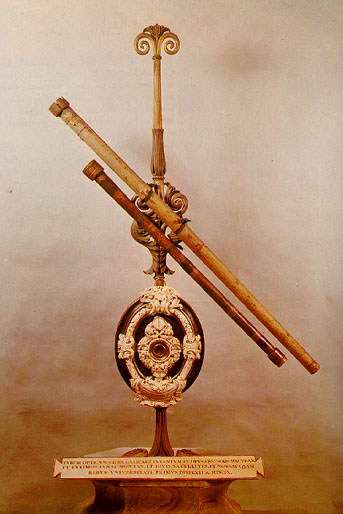
To the right you can see a replica of one of Galileo's early telescopes, as well as a sketch of what he thought the rings of Saturn were.
Support of the Heliocentric Theory
Naturally, Galileo believed in Nicolaus Copernicus' Heliocentric theory, which had been put out a little over a hundred years later. Because Nicolaus had been dead for a while, people had started to slip back into the age-old geocentric theory, which put Earth as the center of the solar system. Galileo tried as hard as he could to convince people that Copernicus was right.
Galileo personally marched up to the Catholic Church and asked them not to ban all the books about the Heliocentric Theory. He argued for a while, and eventually Pope Urban VIII went to Galileo and told him that he could publish a book about heliocetrism on two conditions: 1. The book must include both the pros and the cons of heliocentrism. 2. They also must include Pope Urban's views. Galileo agreed, and went off to start writing his book, "Dialogue Concerning the Two Chief World Systems."
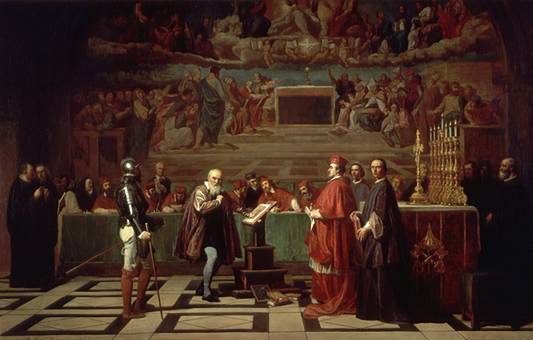
Galileo's book, however, seemed more like a direct advocy of the Heliocentric theory, greatly praising Nicolaus Copernicus' works and making fun of, or even outright insulting, Geocentrism. Pope Urban, who Galileo had previously been on very good terms with, was apoplectic with rage. Furiously, he ordered Galileo's book taken off the shelves and sentenced Galileo to a trial - a trial where nobody was on his side.
Galileo in Trouble
Galileo was officially accused of being a heretic for his writing, and was sentenced to be imprisoned. Gee, that seems a little harsh for putting something forward that was the Pope's idea in the first place!
After being tried, Galileo was on house arrest. He couldn't leave his home and he could have only one visitor per day, which was usually his eldest daughter, Maria Celeste. He and his daughter shared an extremely close relationship, even if she, as a nun, didn't fully agree with his ideas. At first, Galileo was restricted to reading the bible, but eventually he was allowed to review his older work, as long as he didn't "spread it outside."
Galileo then started working on yet another book, this one called "Two New Sciences." It wasn't about the Heliocentric theory, but was instead about gravity and physics. His studies were signficant enough that he earned the name "The Father of Physics," and has been hailed as being one of the most important books of all time, as it deals with the motion of objects and other important physics.
Galileo Galilei's Death...
Shortly after Galileo published "Two New Sciences," he started having heart trouble, and was almost completely blind. He travled to Florence to seek medical attention, and stayed there for his last few years. In 1642, after suffering from heart palpatations, he died, at age 77.
The Grand Duke of Tuscany, who was a good friend of Galileo, wanted to have him put in the Basilica of Sante Croce, which was a mausoleum that held all of his ancestors. But Pope Urban VIII, claiming Galileo to be a heretic even in death, refused, and Galileo was forced to beburied in a small room away from his ancestors, where nobody would greatly acknowledge him.
...And Legacy
So is that the end of the great Galileo Galilei? To have his theories rejected all his life, be claimed as a heretic, and be demeaned even in death, denied a proper burial. Well, luckily, Galileo's story has a happy ending. In 1737, a little less than a century after his death, there was a monument made to Galileo, recognizing his great strides in astronomy and physics. His grave was even moved back into the Basilica of Sante Croce, where he could rest in peace with his family members.
Eventually, the Catholic Chruch reprinted his book, "Dialogue Concerning the Two Chief World Systems," with a couple of censorings. And later, a full, uncensored version was allowed. In 1992, Pope John Paul II made a statement of regret about how the church handled Galileo, and issued a full apology. Later, a monument to Galileo was established in the Vatican.
Galileo Galilei has been hailed by the greatest minds of the scientific world, such as Albert Einstein and Stephen Hawking, as being the most important men in science. And he probably was. Galileo set the standards for the physics and astronomy we use today.
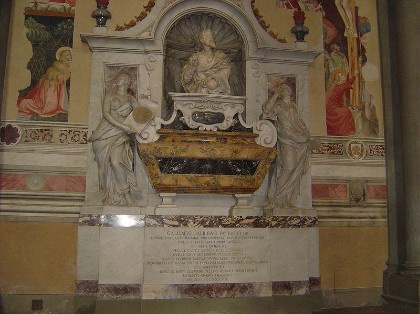
Above: Galileo's grave, after it was moved to the Basilica of Sante Croce, where he belongs.

