Nicolaus Copernicus and His Theory
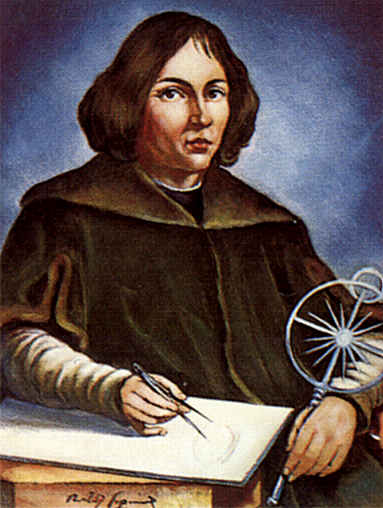
Nicolaus was a Renaissance astronomer who pretty much revolutionized the way we look up at the night sky. Why? Because he put forth the heliocentric theory. This theory has made him so famous that the age of realizing that Earth actually wasn't the center of everything was called the "Copernicun Revolution." Unfortunately, he was very reluctant and secretive with his findings.
The Life of Copernicus
First off, it should be noted that Copernicus' name had many different spellings over the years, including "Kopernikus", and "Coppernik", which Copernicus used as the spelling of his name for quite some time. Despite arguments about his true name, what historians do know is where he was from.
Copernicus was born to a middle-class Renaissance family in Royal Prussia, Poland, on the date of February 19, 1473. Also, like many geniuses of his time, he could speak many languages at a young age: Latin, German, Polish, Italian, and Greek! And as soon as Copernicus was out of secondary school, he attended the University of Krakow in Poland, immediately delving into the wide world of mathematics and astronomy.
Hidden Work
As soon as he was out of the university, Copernicus started looking up at the stars and theorizing what would later become the Heliocentric theory. But he never told anyone about it, for fear of being criticized or even being banned by the Catholic church. See, back then, all the church-folks had ruled that Earth had to be the center of the universe. After all, that's where us humans lived! So Copernicus kept his revolutionary ideas a secret.
Then what did clever Copernicus do? He was a doctor, and a good one at that. Copernicus would be healing sick people and making prescriptions left and right. There are even several letters discovered that were from the Duke Albert of Prussia asking Copernicus what he should do for a toothache!
But in his heart, Copernicus, belonged to outer space. And that's what his real work was about.
Heliocentrism
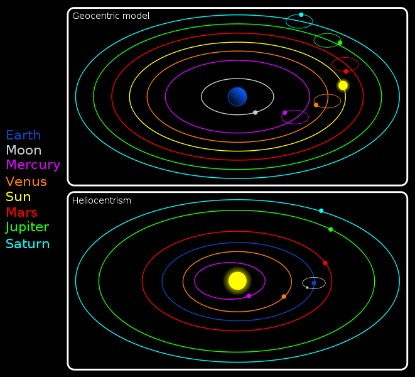
First off, "helio" means sun, and "centric" means center, so heliocentric literally means "the sun in the center." Before Copernicus's work, everyone believed in the Geocentric theory, which put the earth ("geo") as the center, instead of the sun. (See below for a visual look at the two theories)
But Heliocentrism is where the sun is the center of the solar system, and today we all know this. The planets, including Earth, revolve around the sun. Of course, there were still problems. Until the 1920's, when the really high-end Hubble space telescopes came in, nobody knew that there were billions of other solar systems. People thought it was just the one. So they thought that their sun was the center of the universe. But still, saying the sun was in the center was a main idea, and it was still a huge leap forward.
Copernicus's theory of heliocentrism was actually taken from a Greek philosopher over 1,800 years earlier. It was that philosopher, Aristarchus, who first theorized that the sun was in the center, not the Earth. And later, Johannes Kepler and Isaac Newton would also support the heliocentric theory.
So there you have it. Copernicus's theory was rational, fairly provable, and had been supported both in the past and in the future. So why did it take SO LONG to catch on?
Publishing the Heliocentric Theory
Before Nicolaus had published his theory, this is what people thought about the Earth:
-The Earth is the center of the universe.
-The sun and all known planets revolve around the Earth.
-The church supports this theory about the Earth.
-Anyone who says otherwise is a HERETIC!!!
So naturally, Copernicus was extremely reluctant to tell the world that he was the one who had thought of the heliocentric theory.
Copernicus worked harder and harder to make sure that he had enough facts to back up his theory. A colleague of his, Philipp Melanchthon, started working with him on creating his book advertising the theory, which was called "De revolutionibus orbium coelestium." They worked on it for two long years, and then, they finally published it!
The Theory Starts to Hit the Shelves
When Copernicus put forth his theory, it didn't cause as much of a sudden uproar as many people today would think. In fact, many educated people of Poland and Italy had already been reading up on his notes, obtained when Copernicus didn't know. It became an instant hit, for better or for worse, and soon critics came out that were both for and against his theory.
Philip and the rest of Copernicus's colleagues and friends of course were all for the theory. They had the facts! They had the evidence! People all over Europe were starting to think, "This Copernicus guy is pretty sharp!" Copernicus's fear of criticism wasn't needed. His book was even protected further by a preface at the beginning that reminded any would-be angry readers that technically it's JUST A THEORY, and may or may not be true. The Catholic Church even accepted it, with a few minor exceptions. Heliocentrism rocked!
The Death of Nicolaus Copernicus
Nicolaus Copernicus died in Frombork, a small town in his native Poland. He was in a stroke-induced coma, and reputedly woke up with a start, looked down at a copy of his book in his hands, then passed away peacefully and immediately. That was in 1543. He was then buried in Frombork Cathedral, but there may be reason to believe he did not rest in peace.
Since the 1800s, ambitious archaeologists have fervently searched the ruins of Frombork Cathedral for the remains of Copernicus. At first, all they found was a headstone. Finally, though, after thoroughly scanning the floor of the cathedral, the lucky archaeologists found that he was in a tomb buried under the cathedral. The body was very badly damaged, but what features it did have resembled Copernicus's many portraits; additionally, the body looked to have died around the age of 70, when Copernicus passed on.
Copernicus was then reburied in the same spot in the Frombork cathedral. The tombstone is made of black granite, and depicts a sun, with six planets moving around it. It's just what Copernicus would have wanted.
And Then What Happened?
Nicolaus Copernicus changed the world and became one of the most important scientific figures of the Renaissance. But like I mentioned before, things take a long time to catch on. After Copernicus died, unfortunately, the Catholic Church went back to being grumpy about the fact that Earth wasn't the center of the universe. In fact, Galileo, also known as the Father of Modern Astronomy, was almost executed because he believed in the Heliocentric theory.
Nowadays, we're a little more mellow when it comes to different beliefs, and the heliocentric theory has been welcomed by virtually every scientist in the world. But still, a vast majority of people refuse to believe that the sun is the center of the solar system even with overwhelming evidence. As of 2000, 18% of Americans and 20% percent of Brits still believe that the Earth is the center of the solar system.
We've come a long way when it comes to astronomy, but we still have a long way to go.

On the left is Nicolaus Copernicus's signature. It should be noted that it can't be read properly, so modern historians still can't figure out the proper spelling of his name!

