The Life of Leonardo Da Vinci
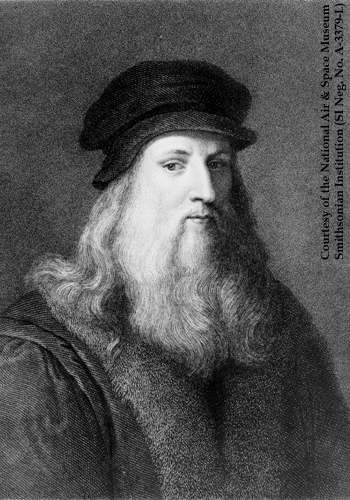
Leonardo da Vinci was perhaps one of the most intelligent men who ever lived. And Shakespeare, seen above these words, is correct: he literally did everything! Leonardo was an inventor, an architect, an anatomist, a painter, and a mathematician all in one. But who exactly was the legendary "Renaissance Man," also known as "The Man Who Wanted to Know Everything"? Read on to find out!
As a Child...
Actually, not much is known for sure about Leonardo's early life. He was born in 1452 in the town of Vinci (Hence his name, Leonardo da Vinci, which literally means, "of Vinci"). Vinci was in the territory of Florence, which was the intellectual center of the world and the boiling pot of the Renaissance.
It seemed that Leonardo from the start was destined for greatness. Leonardo would sometime talk about an omen he encountered as a baby: he was resting in his cradle when a kite flew by, its tail feathers brushing his face. Perhaps the kite was a symbol of Leonardo's later obsession with flying?
Brainchild of the Renaissance
When Leonardo was fourteen, he made his first official painting: a terrifyingly real picture of a fire-breathing dragon or some other sort of monster. An art dealer saw Leonardo painting it and asked for it. Leonardo did, and the art dealer sold it to the great Duke of Milan because it was so good. In return, Leonardo recieved a shield dedorated with an arrow-pierced heart from the dealer as thanks.
That same year, he became an apprentice to an artist named Andrea di Cione in Milan. He was later hired by a variety of artists, architects, and writers, becomeing a temporary apprentice and learning a little about every kind of subject. In his free time he would paint and invent, and in the mean time would become very learned about the natural world. When he was twenty, he left apprenticeship and started working - mainly painting and designing - for money.
Personal Life
Being so super-smart, talented, and busy, you wouldn't think that Leonardo would have much of a social life. Well, guess what? You're actually right! There are virtually no records of Leonardo doing anything other than his work, because painting, sketching, and inventing were also things he did in his spare time. But even Leonardo had a host of friends.
Leonardo was described the people lucky enough to know him as "outgoing and ambitious." He had a striking personality and was fun to be around. But his private life was very... well, provate. He was very protective about his life behind the artist's easel, and most reports say that Leonardo actually never had a romantic relationship with anybody.
Some of Leonardo's friends included King Francis the First of France, as well as Isabella d'Este, a prominent patronist of the arts who Leonardo drew a sketch of on one fateful journey. He also had a rivarly with Michelangelo, despite being about a generation older. There was even a competetion in Florence where the two renowned artists were to each paint a frescoe, and whoever had the frescoe judged to be better won. However, Leonardo scrapped his own painting in frustration, and Michelangelo never finished his, so the contest was a draw!
The Many, Many, Many Accomplishments of Leonardo Da Vinci
Leonardo Da Vinci was one of the most intelligent men who ever lived (you've probably heard me say that a lot, though). This giant section is dedicated to all of his paintings, sketches, and inventions, along with a very short biography about each masterpiece.
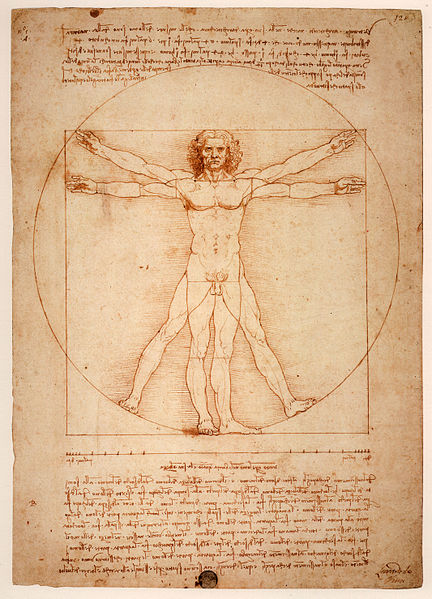
Vitruvian Man
The Vitruvian man is one of the most famous drawings in the world. It is a blend between art and science, and displays the anatomy of an adult male human. It was made to do a lot of size comparisons in the human body; for example, the foot is one-sixth of the height, and the distance from the bottom of the chin to the nose is one-third of the length of the head.
Of course, people come in all shapes and sizes, so there is no universal size comparison. But Leonardo's Virtuvian man came pretty close!
The Vitruvian man is also one of the most reproduced and referenced drawing sor paintings in the world. The Italian 1 cent euro coins, for example, have a picture of the Vitruvian man on them, as a sign of respect for the great mind of the Renaissance.
Human Anatomy Sketches
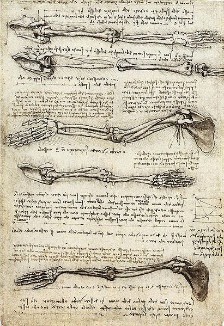
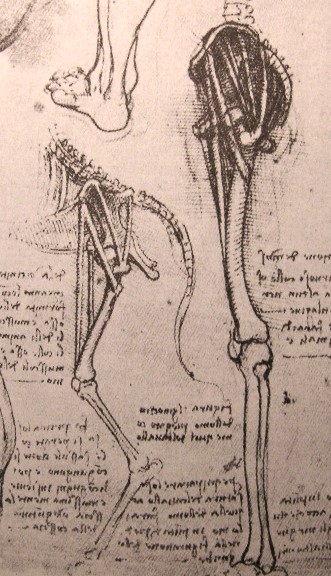
Along with the Vitruvian man, Leonardo also produced hundreds of sketches of parts of the human body. He wanted to know exactly what every body part looked like and what it's function was. Sometimes, he would even go to lengths such as digging up dead bodies just so he could take them back to his office, dissect them, and sketch what he saw.
His numerous human sketches included in-depth views of the skull, the brain, the bones of the arm, and comparisons between human and animal parts. He even has some sketches of a ten to twelve-week old fetus, although how he obtained it is unknown.
Leonardo's Robot
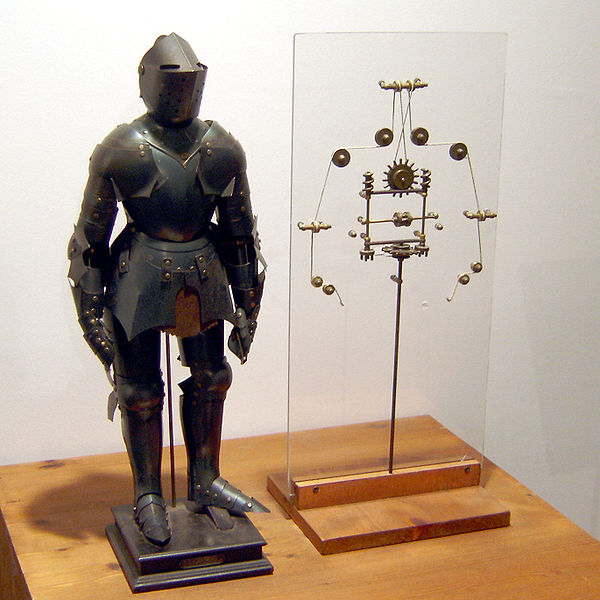
Wait, what? Okay, I knew the Renaissance made great strides in engineering and technology, but a ROBOT? Seriously? You read correctly. Leonardo created this fully animatronic robot in the late 1400s for the Duke of Milan.
The robot is actually quite mysterious. It was completely unknown to the world until many designs of the robot were discovered in the 1950s. There were also notes from Leonardo talking about the success of the robot at the festival in Milan. Unfortunately, the original robot was never found, and is almost certainly destroyed by now.
However, since the sketches of the robot have been found, an exact restoration of wht the robot would have looked like has been made. It functioned using pulleys and levers inside of the robot's clanging suits, and was capable of various ways of movement, such as sitting down and up, and moving its arms. Its anatomy was based on the realistic human porportians of the Vitruvian man. How high-tech!
The Last Supper
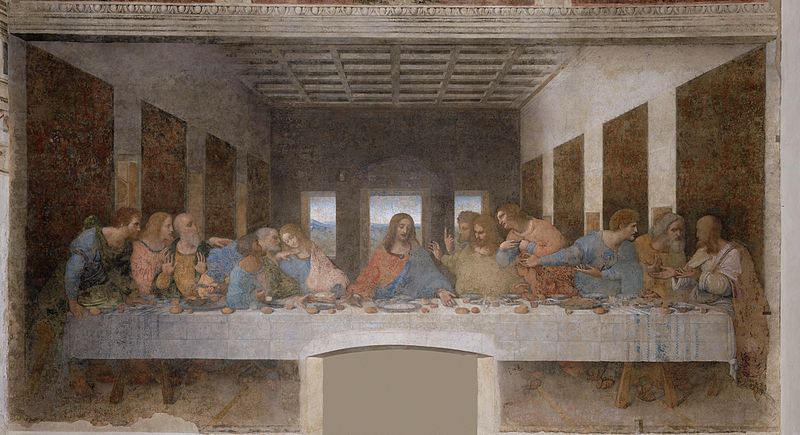
Oh, that Leonardo! So many of his paintings have become famous! And with good reason, too. The Last Supper, in Milan, is another masterpiece of Renaissance painting, showing the advancement of Renaissance paintings over medieval ones. (See the art section in "About the Renaissance" for the major differences between the two art styles.)
The Last Supper is actually a huge mural in the monastery of Santa Maria delle Grazie in Milan, Italy. It measures a whopping 15 feet by 29 feet! It was started in 1495 and finished in 1498.
Mona Lisa
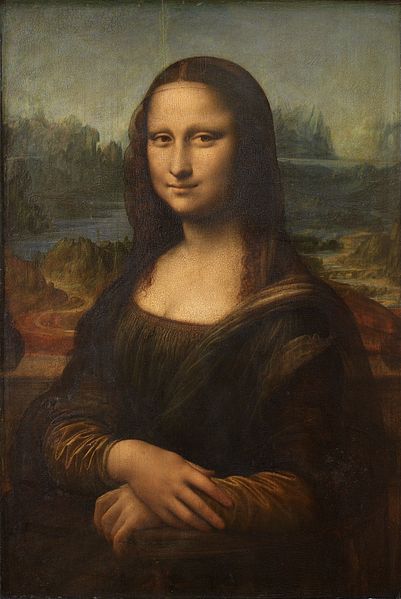
The Mona Lisa (also known as "La Giocanda") is Leonardo Da Vinci's most famous paintings, as well as one of the most famous paintings in the entire world. Leonardo started painting it in 1503, then continued painting it on and off until he finally completed it shortly before his death in 1519.
The Mona Lisa's home is in the Musee du Louvre in Paris. Though it was already very popular, its fame exploded when it was stolen in 1911. There was a huge two-week search for it, then the painting was given up for lost.
After two long years, it turned out that an Itialian patriot named Vincenzo Peruggia had stolen it, claiming that it belonged to Italy. How did he do it? Well, security of the Mona Lisa wasn't nearly as tight as it is now. Peruggia simply came in just before the museum closed and snatched it. Then, he hid in a closet for a few hours, until he was sure nobody was left in the building. That night, he quickly walked out of the museum, with the Mona Lisa stuffed under his overcoat!
The Mona Lisa was retrieved and place back in the Louvre, where it rests to this very day. It should also be noted that Peruggia was praised as a hero to Italy for being so patriotic, and only served a six-month jail time for his crime.
Also, you may notice that the Mona Lisa doesn't have eyebrows, or even eyelashes. Historians used to claim that this was because it was the "thing" in those days for all women to shave their body hair completely off. But extensive x-ray scans have now shown that the painting actually has faint signs of eyebrows, which ahve faded over time ffrom numerous accounts of cleaning the painting. Go figure!
The First Helicopter - Leonardo's Quest for Flight
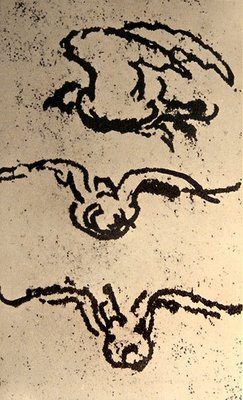
Ever since Leonardo was a child, he was obsessed with flying. He would always watch hawks flying through the sky, carefree and limitless. Some of his biggest endeavours involved getting up in the air, including his primitive helicopter.
One of Leonardo's favorite things to draw was birds: bird wings, bird feathers, birds in flights; he would design entire makeshift planes with wings designed after bird wings. He would make designs for parachutes and hang gliders. When it came to flying Leonardo tried everything.
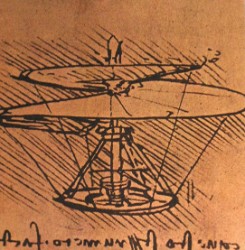
Leonardo's helicopter was designed in the form of a spiral, which he saw as the most aerodynamic form. Many of his helicopter's designs used just one man to power it, but his most famous used four. In the picture to the far right, there would be four men standing where his lines are pointing. In the process of building his many helicopters, Leonardo also invented the first barometers. Unfortunately for Leonardo, his helicopter never truly got off the ground. Legend says that one of his apprentices tested it out by jumping off a hill by Leonardo's home. The apprentice crashed-landed and broke his leg.
It's a shame that Leonardo wasn't born in a later time, when knowledge about aerodynamics and flight was much more extensive. However, Leonardo ultimately spawned humanity's interest in flight, and many modern designs have been based on Leonardo's early, hopeful sketches.
Leonardo's Later Life and Death
Leonardo's later years were spent in his new home, the Vatican City in Rome. He was praised as the most accomplished artist and inventor of the time. He continued being a close friend to Francis the First, King of France.
Leonardo da Vinci died on May 2, 1519, at the relatively old age of 67. Reportedly, he died in his friend Francis' arms, although this is probably a legend. Naturally, he left behind a treasure trove of his sketches, designs, and paintings. Most were given to his friends and two brothers, and of course, many of them found their way into famous museums, where they are praised as national treasures.
Legacy of the Man Who Wanted to Know Everything
Leonardo da Vinci did everything. He painted paintings, made anatomical sketches, designed machines, and ultimately became so fascinated with the notion of flying that he set the standards for other starry-eyed inventors half a millenium in the future. He was one of the smartest, most imaginative men on Earth. He truly was a living, breathing Renaissance Man, and the legacy of his imagination, as well as all of the paintings and inventions he left behind, still live on today.

