Michelangelo: Another Renaissance Man
Michelangelo is similar to Leonardo da Vinci: He was born in the 1400s in Italy, lived well into the 1500s, and was a true man of the Renaissance, having almost as wide a diversity in his interests as the great Leonardo himself. But instead of being more into engineering and natural sciences, Michelangelo preferred to stick with painting and sculpting. But the things that he did paint and sculpt are some of the most fantastic pices of art in the world!
Early Life of the Renaissance Artist
Michelangelo, like most people born in Italy back then, actually had an extremely long full name: Michelangelo di Lodovico Buonarroti Simoni. Try saying that five times fast! Anyways, he was born in Tuscany, Italy, in 1475, but soon moved with his family to Florence, the intellectual center of the world.
Michelangelo's father was a government official, and wanted his son to follow in his footsteps. But young Michelangelo did not enjoy grammar school or law. He preferred spending his days making beautiful paintings, and generally hanging out with other artists.
Becoming a Professional
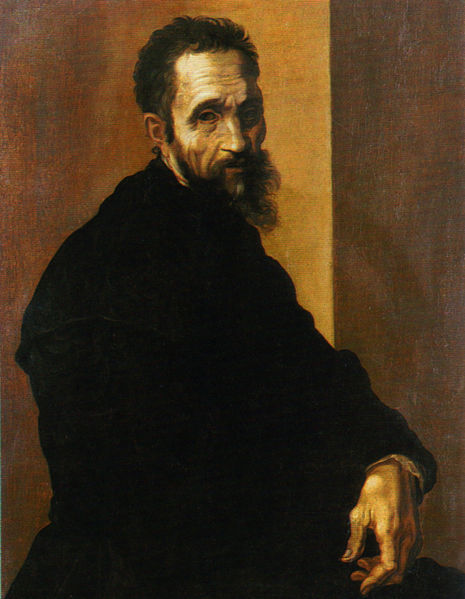
Luckily for Michelangelo, his father finally became accepting of the fact that Michelangelo really wasn't that into politics. At age thirteen, Michelangelo became an apprentice to another artist, Domenico Ghirlandaio. Only a year later, Michelangelo was proficient enough in painting that he could start getting paid for his works of art. He then attended an art academy. There, he made one of his first painting of his career, the Battle of the Centaurs (1491). He also took a nasty hit: one of his rival students, sculptor Pietro Torrigiano, once got angry at Micheangelo, and took a slug at him that broke his nose, disfiguring it. The slight disfigurement could still be seen in his later years (see the potrait at left, drawn when Michelangelo was in his sixties.)
Sculptures of Michelangelo
Michelangelo made a lot of sculptures in his lifetime, starting when he was around seventeen and continuing until his final days. He was one of the first sculptors since the long-ago Greeks to truly capture the human physique, muscles and all. His sculptures were some of the most realistic in the Renaissance.
Battle of the Centaurs
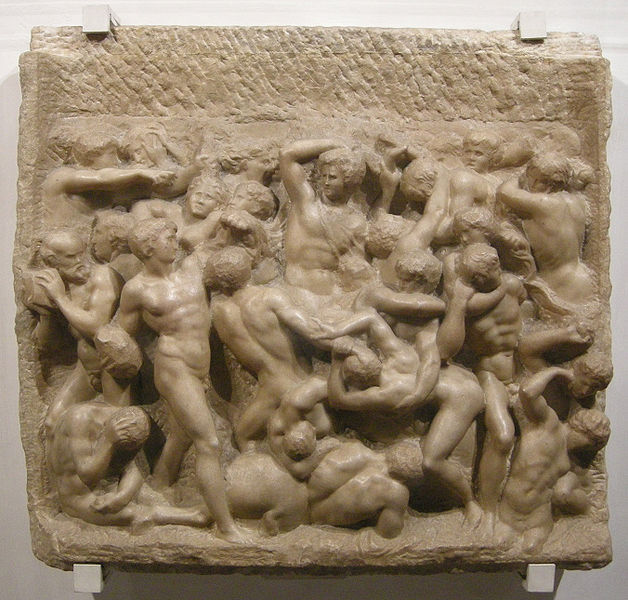
As stated above, the Battle of the Centaurs was one of the first sculptures made by Leonardo, just out of the academy. The sculpture depicts a skirmish between two rival enemies in ancient Greek culture: the Lapiths and the Centaurs (no, not the half-horse, half-man centaurs).
And just look at it! All those figures! All those positions of their arms and legs and heads! From their muscle tone to their facial expressions, everything about them was beautifully depicted. Michelangelo worked on it for about a year, then leaves his Lapiths and Centaurs unfinished. Or did he?
Many historian believe that he intentionally left it unfinished, for reasons unknown. Perhaps he thought the sculpture was good enough as it was. Either way, he soon left The Battle of the Centaurs and started working on other, even more amazing, sculptures.
Pietà
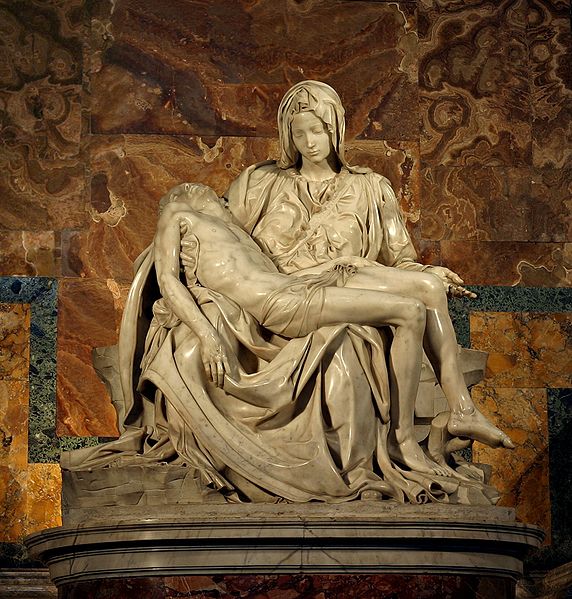
The Pieta, probably Michelangelo's most famous sculpture after David, was started in 1498, and finished a year later. The person who commisioned Michelangelo to make it was the current visiting cardinal. It was first put in Saint Peter's Basilica in Vatican City and remains there to this day.
The Pieta shows Jesus Christ after his crucifixion, in his mother Mary's lap. One interesting thing about the sculpture is that Mary looks young and flawless, instead of a woman in her fifties as she should have been. This is because, according to Michelangelo, Mary's youngess was supposed to represent her purity. The figures, too, are disproportional, but this is probably because Michelangelo found it hard to sculpt a fully grown man in Mary's lap, and had to make his smaller.
And my, oh my, has it taken some damage over the years! In 1736, Mary had three of her fingers broken off when the Pieta was being moved. And another time, a mentally disturbed geoligist stared hitting the Pieta with a giant hammer, making dents in the sculpture and destroying Mary's nose. The work was pain-stakingly restored, and nowadays it is never moved. However, several copies have been made.
Another thing worth noting is the fact that this was Michelangelo's only work of art that he ever signed, on a sash on Mary's neck. He later regretted this, vowing that he would never sign any of his works ever again.
David
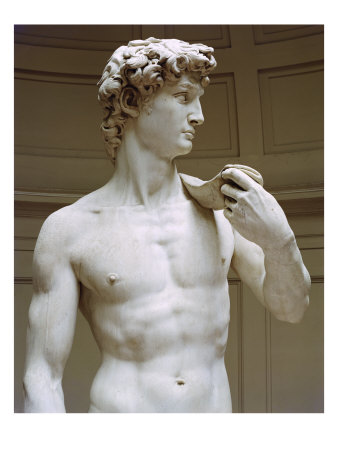
Between 1501 and 1504, Michelangelo sculpted David, based on the hero of the biblical story of David and Goliath. Sculptures opf David had already been made during the Renaissance, namely a bronze one created by Donatello, but none of the previous Davids compare to Michelangelo's version.
First of all, David was huge: 17 feet high from the soles of his giant feet to his thick curly hair! And he was six tons as well; that's as heavy as three elephants! It was made out of marble. Originally, David was to be positioned on the roof of the Florence Cethedral, but that proved too hard. Instead, it was put in the public square outside the "town hall" in France. In 1873, the original David was moved to its current home in the Academia Gallery, and an exact replica was moved into the plaza.
As usual, Michelangelo captured the human body brilliantly: David is seen staring intently into the distance, a scowl on his face. He is standing upright, but leaning back, his right hand on his right thigh. You can even see the veins in his hands. Many, many reproductions have been made of David, including one in the Alfred and Victoria Museum in England. It has a removable fig leaf to cover up David's privates because Queen Victoria was apparently shocked when she first saw David. And what the queen says, goes!
David was an epic milestone in art and sculpturing. And Michelangelo even did it when he was only twenty-six years old! Still, David is seen by most as not quite the greatest work by Michelangelo. That prize is awarded to...
The Sistine Chapel
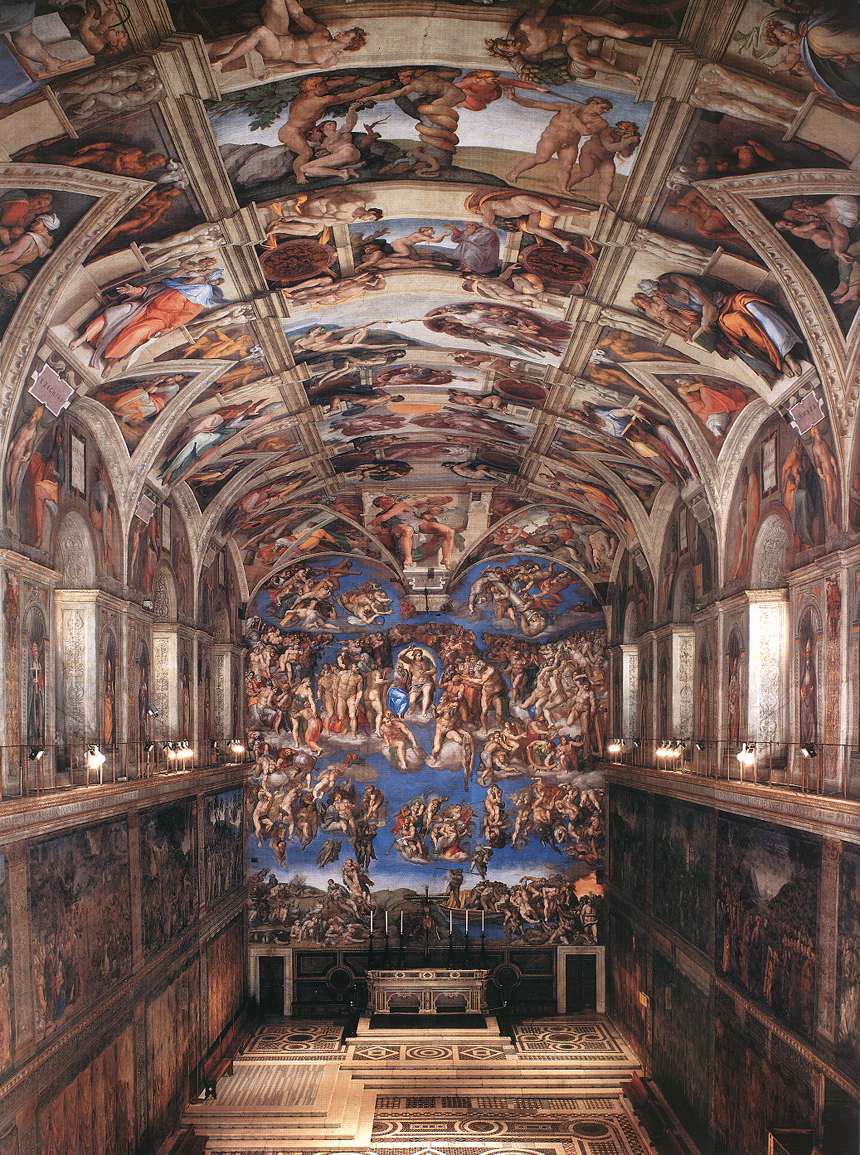
The Sistine Chapel is one of the ultimate works of art of the Renaissance. Why? For starters, the inside of the entire chapel was handpainted into beautiful biblical stories and pictures! It took 10 years to complete! Take a look at the picture below to get a small idea of the awesomeness of the Sistine Chapel.
Creation of a Masterpiece
Fun fact: Michelangelo had to paint a total of 12,000 square feet of wall and ceiling to complete the Sistine Chapel. He started in 1508 and finished in 1518. Originally, Michelangelo was just told to paint stars on a dark background for the celing, but it soon grew into something much bigger. Michelangelo was originally very intimidated at the prospect of painting an entire chapel, but after much pestering by Pope Paul lll, he finally set to work.
The Ceiling
The first thing Michelangelo did on the Sistine Chapel was the ceiling. But before he could start building, there was one problem: how could he paint something so high in the air!
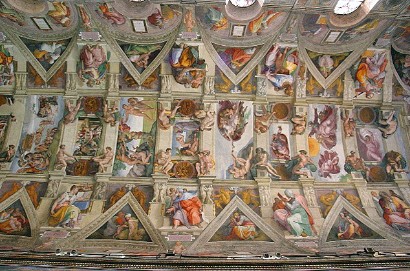
Michelangelo designed his own scaffold, in which he climbed up on nearly every day. He would then proceed to lie on his back and paint, paint, paint. The ceiling depicts a total of nine stories from genesis, the most famous one being the one smack dab in the center of the chapel's ceiling. The famous painting is of God giving the touch of life to Adam.
The Last Judgement
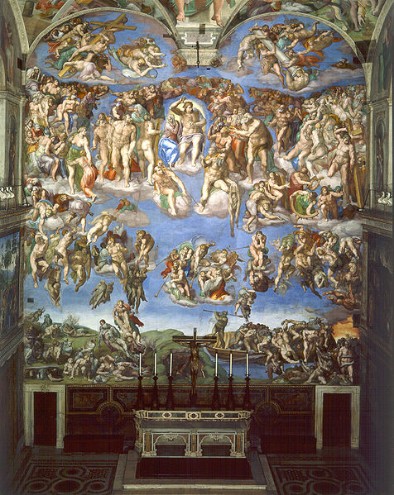
Michelangelo saved The Last Judgement for the end, and spent six of the ten years working on it. The Last Judgement, which depicts the coming of Christ and the apocalypse, lies on the wall at the very end of the chapel. In truth Michelangelo did not like painting the Last Judgement, and only made it because the chapel had to be completed. There was also controversy about the nudity of many of the people in the painting, and the painting was censored for a long time. Regardless of any controversy surrounding The Last Judgement, it still remains one of Michelangelo's greatest works, and one of the greatest works of the Renaissance itself.
Restoring the Sistine Chapel
The Sistine Chapel had been restored, at least minorly, all through the centuries, but no restoration has been as significant - or as debated - as the restorations in 1980 and 1994.
Before the restoration of the Sistine Chapel, it was actually quite dull and drab in color. After over four hundred years of exposure to the world, it started graying into monochrome. Many scientists also think that it could be from the thousands upon thousands of people that had visited the Sistine Chapel over the years: the carbon dioxide in people's breath would have been slowly but surely flaking the paint away. Other suspects for the painting's graying are cracking of the plaster, staining from water flow, and salt deposits.
Either way, the Sistine Chapel was fixed, and now is as beautiful in design and color as it was back when Michelangelo first painted it. Although many people were against the restoration, it was still carried through.
Also: All three pictures to the left and above are from the restored Sistine Chapel.
Michelangelo's Death and Legacy
Michelangelo lived a long, fulfilling life, completing many great works of art. His last work was as an architect for St. Peter's Basilica, where the Pieta was. In fact, he barely completed it before he died. But he still managed to complete it, and passed away serenely in Rome just three weeks away from his 89th birthday. He was asked to be buried in Tuscany, his beloved home.
Michelangelo was not only one of the greatest artists of his time, but of all time. He was a master painter, sculptor, and designer, and his works of art remind us that you really can achieve a lot in a lifetime. Much like Leonardo da Vinci, he was a true-to-his-name Renaissance man.

